
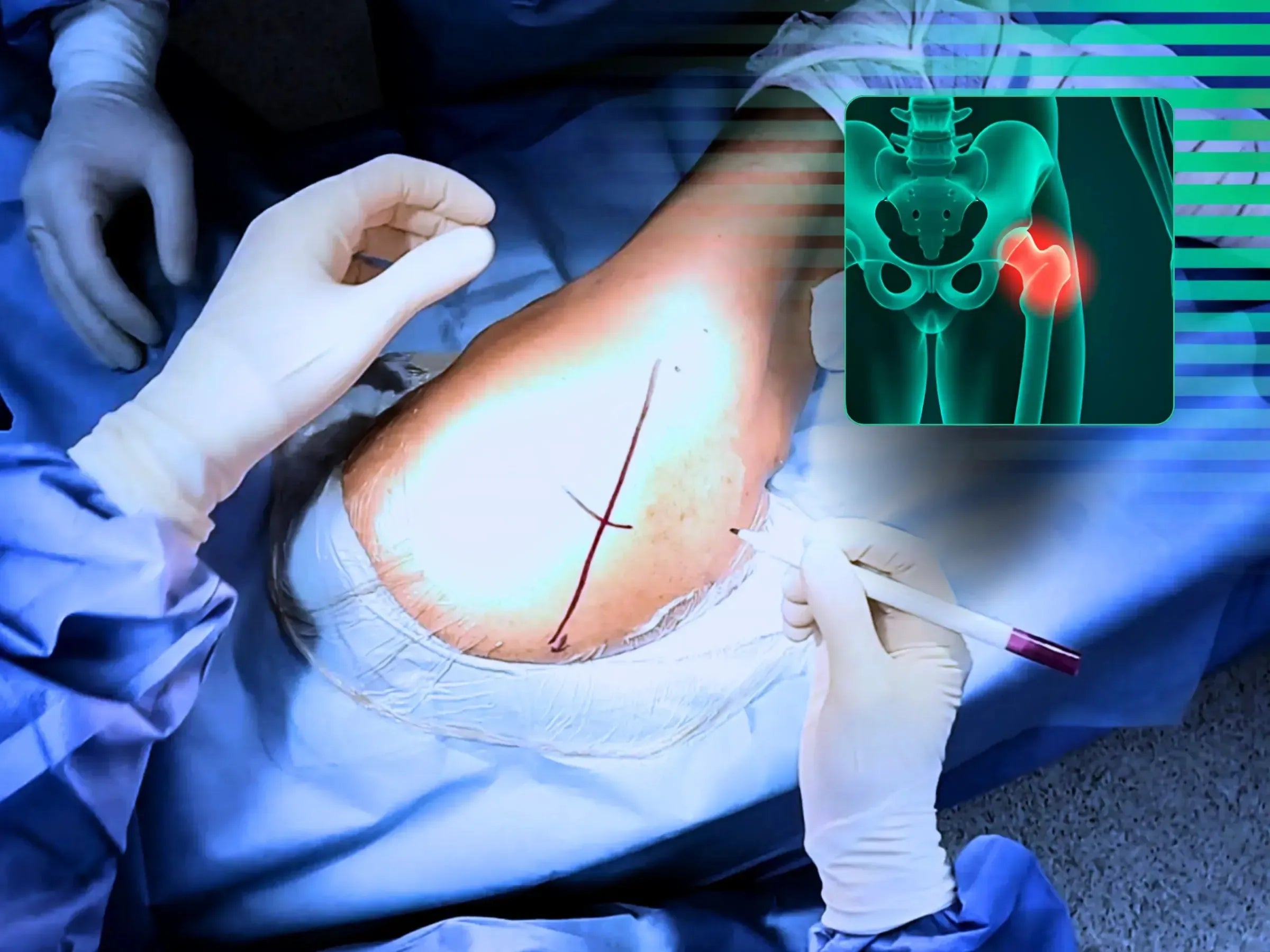


Total Hip Arthroplasty (THA) via Posterior Approach for Coxarthrosis
Posterior THA: Deepen your surgical mastery in hip arthroplasty for functional restoration.

Dr. Savio Chami
Médico Ortopedista
Available at::









4k videos
Professional Dubbing
Escolher opções
Total Hip Arthroplasty (THA) via Posterior Approach for Coxarthrosis
Preço promocionalR$ 0,00
Dr. Savio Chami
Médico Ortopedista
Questions & Answers loading...
Description
The treatment of hip osteoarthritis demands surgical precision and technical mastery for functional hip restoration. This training offers an immersion into total hip arthroplasty via the posterior approach, detailing each step of the procedure, from skin marking to anatomical closure, and providing strategies for optimized outcomes.
Training Focus:
- Total hip arthroplasty via the posterior approach.
- Acetabular and femoral preparation techniques.
- Soft tissue and external rotator management.
Detailed Content:
- Strategic Patient Positioning and Skin Marking: Methodology for positioning the patient in a lateral decubitus position with 45 degrees of hip flexion and precise identification of anatomical landmarks (posterior superior iliac spine, femoral diaphysis, apex of the greater trochanter) for surgical field optimization.
- Controlled Exposure and Anatomical Preservation: Techniques for approaching the external rotators and capsulotomy, including the management of a shortened piriformis in arthrosis cases and the use of the 45-degree Hohmann retractor for lifting the gluteus medius and minimus.
- Safe Dislocation and Precise Osteotomy: Systematic approach for hip dislocation with a retractor positioned on the lesser trochanter and osteotomy marking.
- Optimized Acetabular Preparation: Protocols for complete labral and soft tissue debridement, subchondral bone exposure, and reaming technique starting from the acetabular floor to prevent "high hip," ensuring the mold for the implant.
- Acetabular Reaming with Angle Control: Strategies for establishing the correct angle, protection of the roof and posterior region, and continuous reaming for uniformity and prevention of an oval shape.
- Femoral Preparation for Stability: Sequence for initiating femoral broaching from the lateral side to prevent varus, maintaining alignment for femoral anteversion control.
- Stability Testing and Prosthesis Evaluation: Methodology for stability testing with a trial head (start with a zero head) and confirmation of appropriate component size.
- Definitive Insertion and Anatomical Closure: Systematic approach for definitive component insertion, direct visualization joint reduction, and anatomical closure of the external rotators (including the piriformis).
- Layered Closure for Aesthetics and Functionality: Techniques for complete closure, fascia (iliotibial tract), subcutaneous tissue, and skin, following dermographic marks for a favorable aesthetic result.
Included Material:
- Detailed PDF: A comprehensive guide covering each step of Total Hip Arthroplasty via the posterior approach, from initial patient positioning and skin marking, through soft tissue and external rotator dissection techniques, to the intricacies of acetabular and femoral preparation, and strategies for anatomical and functional closure. The material includes practical summaries of key steps and insights for optimizing surgical outcomes.
Enhance your hip surgery skills. Enroll now and master the techniques in total hip arthroplasty via the posterior approach for hip osteoarthritis.
